

Scoring vs. Selection
The Scoring process defines how the strategy evaluates each eligible security. At each reconstitution date, BIASafe calculates the selected metrics, normalizes them, and combines them into a single score for each security.The Selection process defines how the strategy turns those scores into a final list of securities. A selection rule can rank securities and keep a defined slice, such as the top 100, top 20%, or a middle-ranked band. It can also apply a threshold and keep every security whose score passes the cutoff.For example, a strategy may score the universe using 12-month momentum and low volatility, then select the top 100 securities by combined score. The score answers how good is each security? The selection rule answers which securities do we keep?
Note: Scoring and selection work together. A step that only scores passes every eligible security forward with a score attached. A step with a selection rule first scores the securities, then applies the rule. Selection always operates on the step’s combined score, not directly on an individual raw metric.
The Selection Pipeline
Security Selection runs as a cascade. The eligible universe enters the pipeline, and each step scores the securities it receives, applies its selection rule, and passes the survivors to the next step. A security must pass every step to be selected. This cascading design makes each score relative to its context. A security that looks above-average on value among all 2,400 names in the universe may look below-average among the 200 quality survivors of an earlier step. Because each step re-scores within the survivors it receives, the score always reflects a security’s standing among the names still in contention.Long and Short Legs
A strategy selects securities on one or two legs:- Long Position: the long leg always runs. Its final survivors are the securities the model holds long.
- Short Position: the short leg runs only for long-short strategies. It is configured independently, with its own steps, metrics, and rules.
The long leg runs first. The short leg then starts from the eligible universe minus the long-leg survivors, so no security can be selected long and short at the same time. The two legs never overlap.
Steps and Cascading
Each leg is a sequence of up to three steps. Steps run in order, and each step narrows a single survivor set that feeds the next. Every step has two parts:- Scoring: which metrics define the score, and how they combine into one number.
- A selection rule: how that score is turned into a keep-or-drop decision.
Security Scoring
Selection Rules
The selection rule converts the combined score into the step’s survivor set. There are two rule types, matching the two filter types.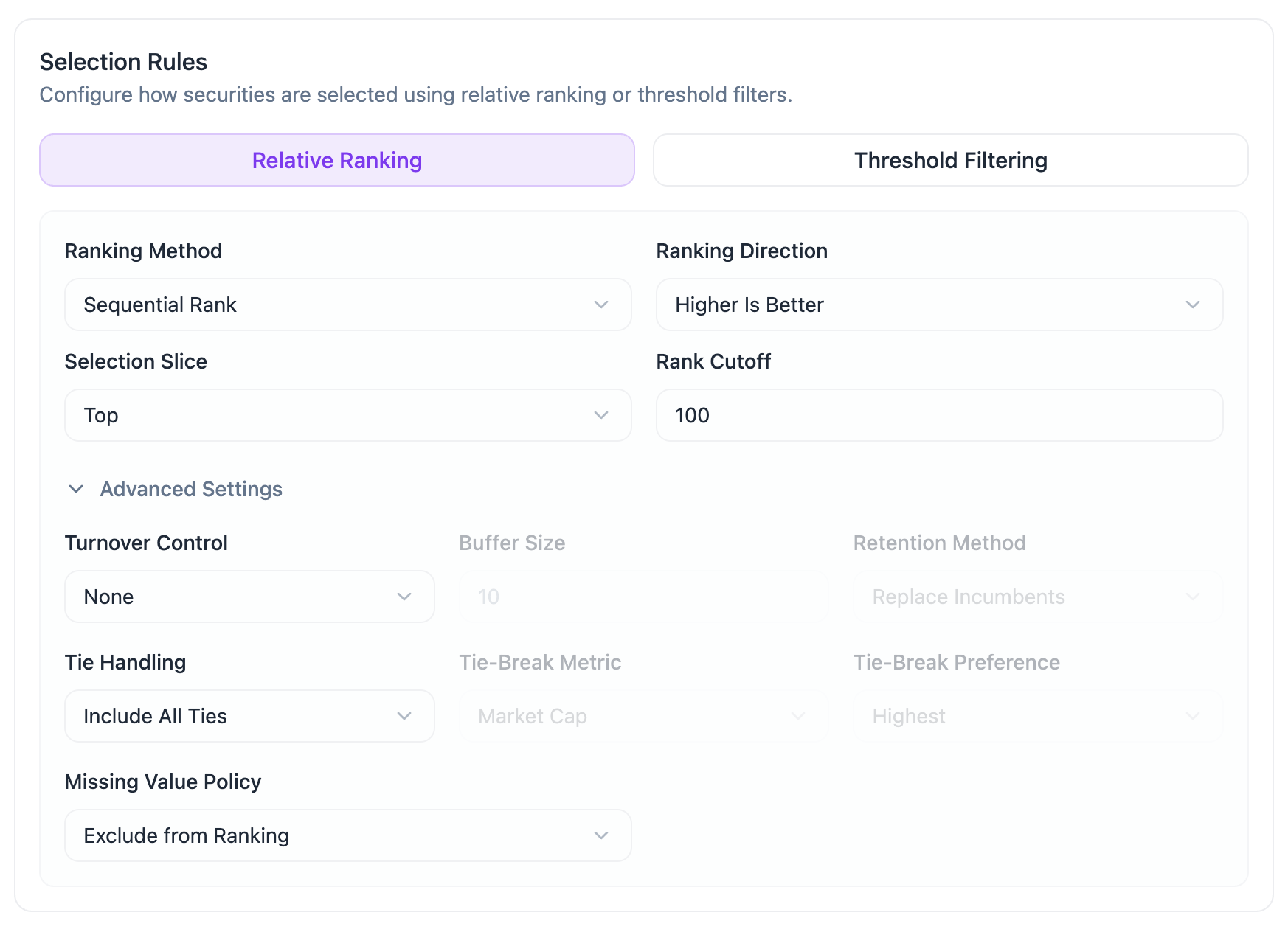
Relative Ranking
A Relative Ranking selects securities based on their position in the ranked list of combined scores. At each reconstitution date, BIASafe takes the securities entering the step, calculates their combined scores, ranks them, and keeps the part of the ranking defined by the user. This can be a fixed number of securities, a percentage of the universe, or a band within the ranking. The cutoff is relative to the score distribution at that step. It is not an absolute score value. For example, selecting the Top 20% does not mean the score must be above a fixed number. It means BIASafe keeps the best-ranked 20% of securities available at that reconstitution date, regardless of where the actual score cutoff falls.Ranking Method
The Ranking Method defines whether the filter keeps a fixed number of securities or a fixed proportion of the ranked universe.- Sequential Rank: keep a fixed count (e.g. the top 100).
- Percentile Rank: keep a fixed percentage (e.g. the top 20%).
Direction
The Direction defines whether higher or lower scores are preferred.- Higher Is Better: larger scores rank first. This is commonly used for metrics where higher values are preferred, such as momentum, profitability, growth, or quality scores.
- Lower Is Better: smaller scores rank first. This is commonly used for metrics where lower values are preferred, such as volatility, valuation multiples, leverage, drawdown, or risk measures.
| Direction | Slice | Result |
|---|---|---|
| Higher Is Better | Top | Keeps the highest scores |
| Higher Is Better | Bottom | Keeps the lowest scores |
| Lower Is Better | Top | Keeps the lowest scores |
| Lower Is Better | Bottom | Keeps the highest scores |
Slice
The Slice defines which part of the ranking is kept after scores are ordered.- Top: keep the best end of the ranking.
- Bottom: keep the worst end of the ranking.
- Between: keep a middle band defined by a lower and an upper cutoff.
Threshold Filtering
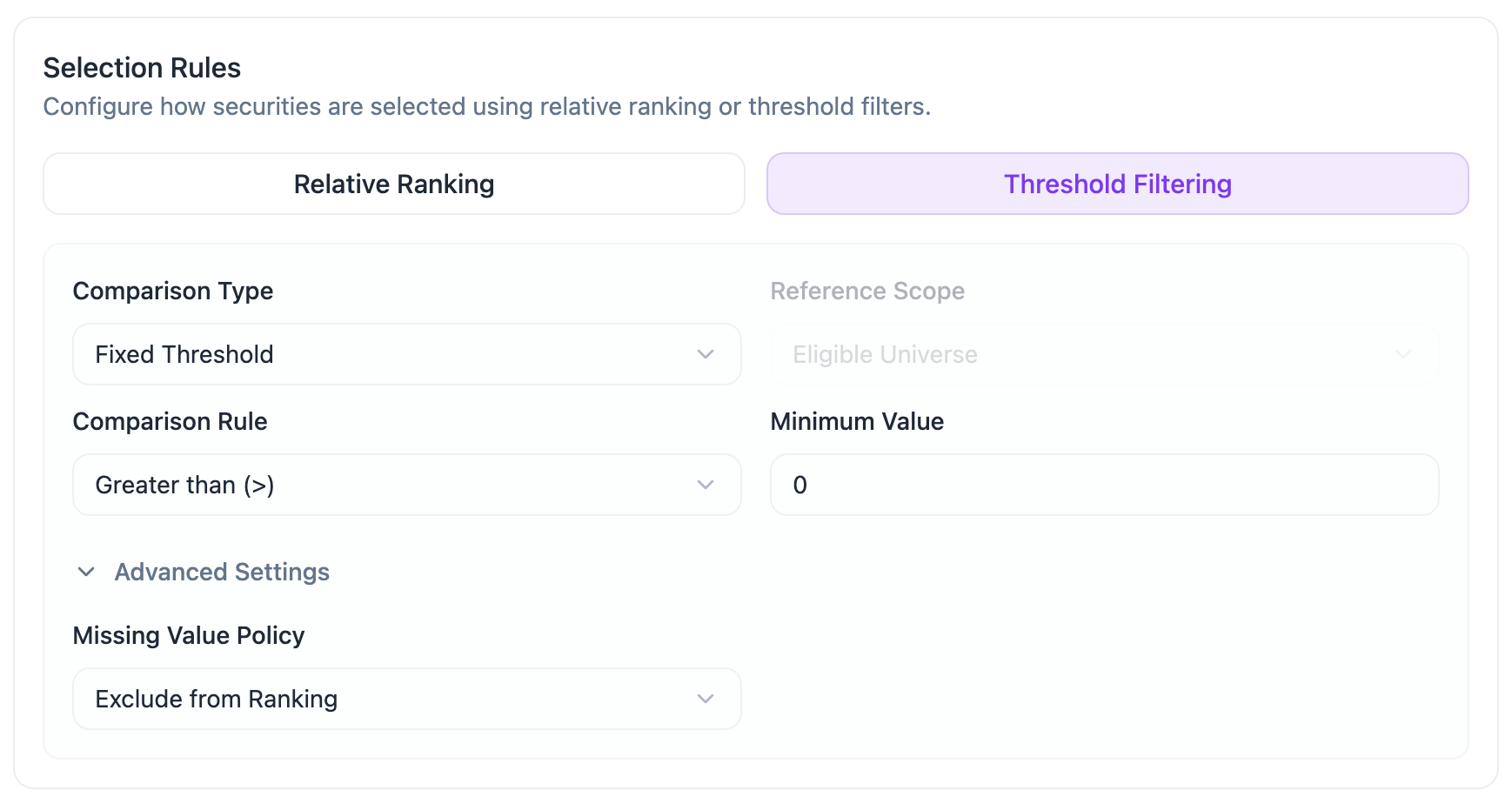
Comparison Type
The Comparison Type defines how the cutoff is determined.- Fixed Threshold: compares each security’s combined score against a value entered by the user. For example, if the rule is Greater Than 0, BIASafe keeps every security whose combined score is positive.
- Dynamic Reference: compares each security’s combined score against a statistic calculated from a reference population. For example, the rule may keep every security with a score above the mean or median score of the eligible universe.
Dynamic Reference Settings
Dynamic Reference Settings
Reference Scope
For Dynamic Reference, the Reference Scope defines the population used to calculate the threshold.- Eligible Universe: Uses the securities entering the current selection step. This means the dynamic threshold is calculated only from the securities that survived the previous filters and steps.
- Starting Universe: Uses the original universe at the beginning of the selection leg, recalculated using the current step’s metrics. This allows the threshold to be anchored to the broader starting universe instead of only the securities that reached the current step.
Reference Statistic
For Dynamic Reference, the Reference Statistic defines which statistic is used as the cutoff.- Mean: Uses the average combined score of the reference population.
- Median: Uses the middle combined score of the reference population.
Comparison Rule
The Comparison Rule defines how each score is evaluated against the selected threshold. Available rules include:- Greater Than: Keeps securities with scores above the threshold.
- Greater Than or Equal: Keeps securities with scores at or above the threshold.
- Less Than: Keeps securities with scores below the threshold.
- Less Than or Equal: Keeps securities with scores at or below the threshold.
Thresholds are applied to the step’s combined score, not to individual raw metric values.Use Dynamic Reference when the cutoff should adjust with the market or universe. Because the mean or median is recalculated at each reconstitution date, the threshold adapts as the score distribution changes over time.
Turnover Buffer
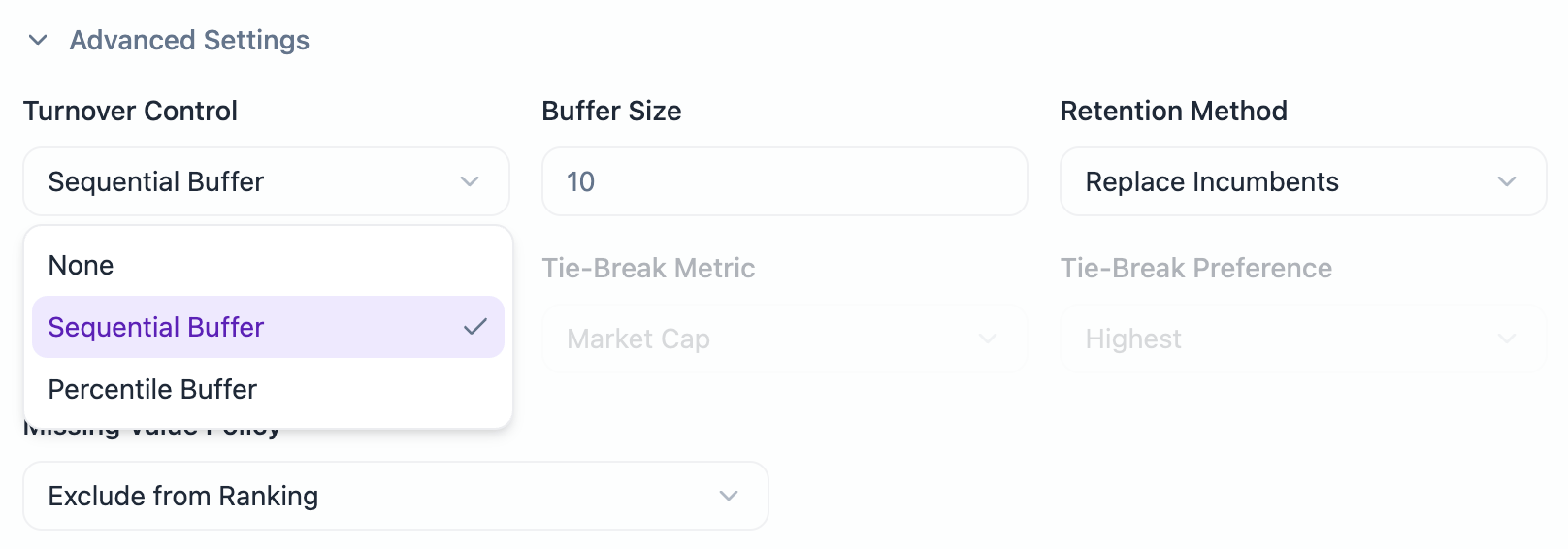
Buffer Zone
The turnover buffer works by combining the model’s existing selection cutoff with an additional buffer threshold. The buffer threshold defines how far an existing holding can drift before it is removed. The area between the selection cutoff and the buffer threshold is the buffer zone. It prevents the model from replacing an existing holding with a new security when the difference in rank is marginal. Because of this, new securities and existing holdings are treated differently:| Security’s new rank | If not currently held | If currently held |
|---|---|---|
| Inside the Selection Cutoff | Added | Kept |
| Within the Buffer Zone | Not added | Kept |
| Beyond the Buffer Threshold | Not added | Dropped |
Buffer Type
The Buffer Type defines how the buffer width is measured. It can be expressed two ways:| Buffer Type | How it works | Example |
|---|---|---|
| Rank Buffer | Uses a fixed number of additional ranks. | Top 100 with a 20-rank buffer keeps existing holdings until rank 120. |
| Percentile Buffer | Uses additional percentile points of the ranked universe. | Top 10% with a 2% buffer keeps existing holdings until the top 12%. |
Replacement Method
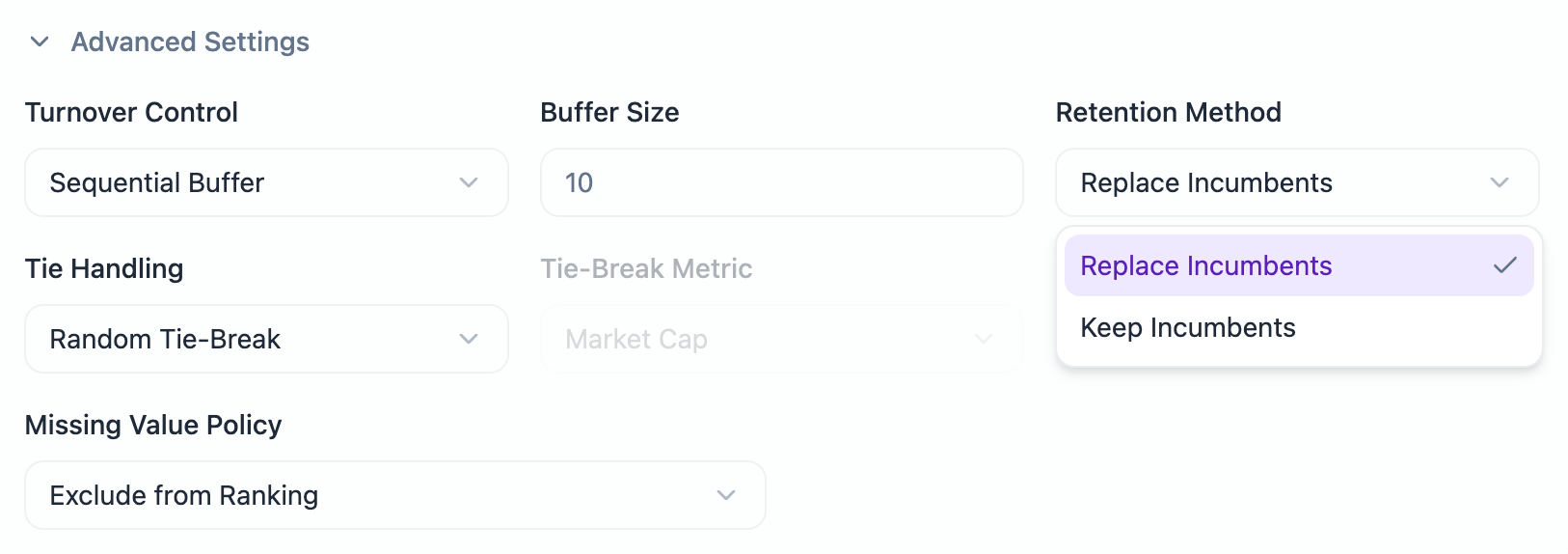
| Replacement | Behavior | Portfolio Count |
|---|---|---|
| Keep Incumbents | Retains all existing holdings that remain inside the buffer zone. | May exceed the target count. |
| Replace All | Retained holdings replace the weakest new entrants one-for-one. | Exact target count. |
Replacement Method Settings
Replacement Method Settings
Keep Incumbents (default)
It retains all existing holdings that remain inside the buffer zone, even if this causes the portfolio to hold more securities than the normalThis option provides the strongest turnover reduction, but the number of holdings may vary within the buffer range.For example, if the model normally selects the top 100 securities, the portfolio may temporarily hold more than 100 securities when several existing holdings remain inside the buffer zone.Replace All Incumbents
Replace All keeps the portfolio count fixed at the selection cutoff.Existing holdings inside the buffer zone are still given priority, but they replace the weakest new entrants one-for-one. This preserves the turnover-control benefit of the buffer while keeping the number of holdings fixed.Use this option when the strategy requires an exact number of securities at each reconstitution.Tie Handling
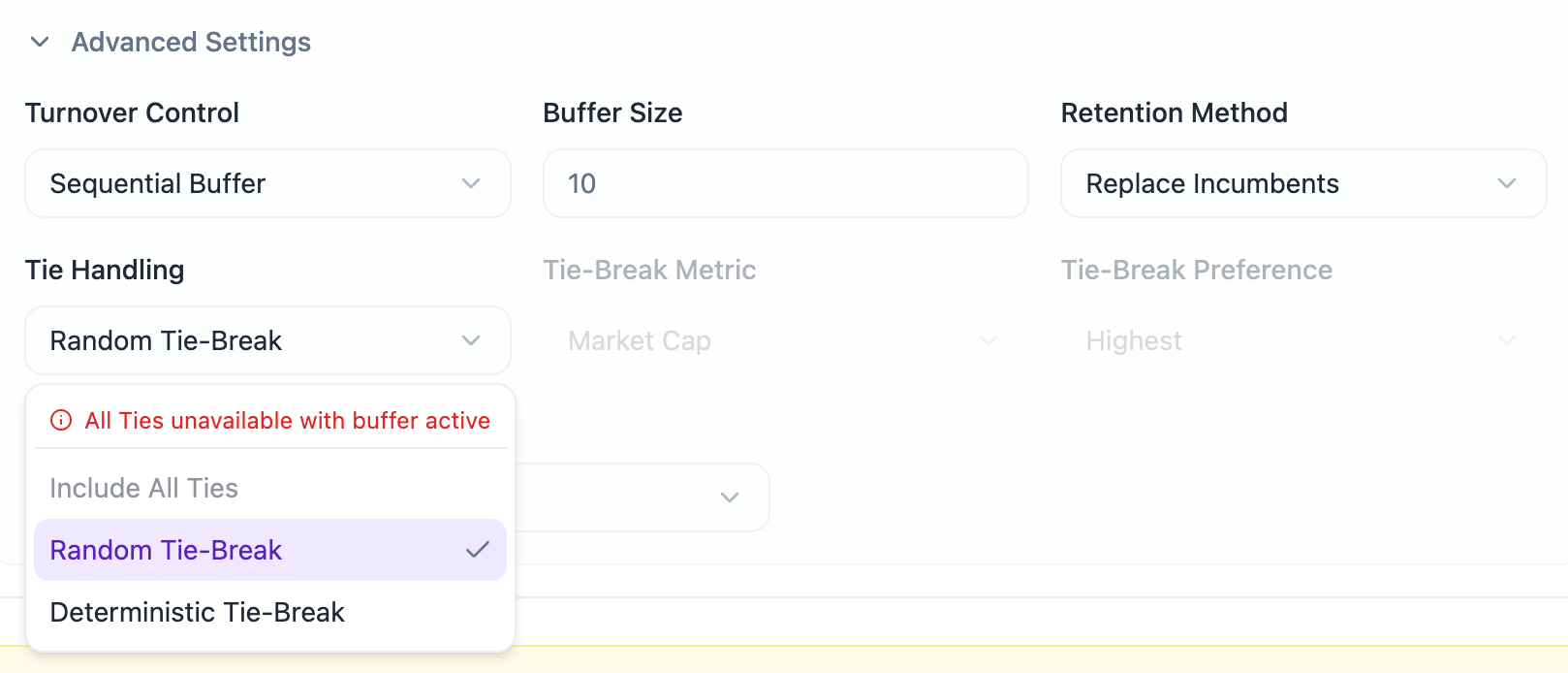
Tie Handling does not apply to Threshold Filters, because threshold filters keep every security that meets the cutoff instead of enforcing a fixed number of securities.
| Tie Handling | Behavior | Portfolio Count |
|---|---|---|
| Include All Ties | Keeps all securities tied at the selection boundary. | May exceed the target count. |
| Random | Randomly selects from the tied securities to fill the remaining seats. | Exact target count. |
| Deterministic | Breaks ties using a secondary metric and a final security identifier tiebreaker. | Exact target count. |
Tie Handling Settings
Tie Handling Settings
Include All Ties
Include All Ties keeps the full group of securities tied at the boundary. This is the most neutral option when securities are indistinguishable based on the selected score. The final selection may be larger than the target count.For example, a top 100 filter may return 103 securities if four securities are tied for the final available position.Use this option when it is preferable to include a few additional equivalent securities rather than force an arbitrary cutoff.Random Tie-Break
Random Tie-Break fills the remaining seats by randomly selecting from the tied securities. By default, the selected securities may differ across runs when ties occur. Users may provide a random seed to make the result reproducible. With the same seed, the same tied securities are selected each time.Use this option only when random selection is acceptable for the strategy design.Deterministic
Deterministic resolves ties using a secondary tie-break metric. Users select:- Tie-Break Metric: The metric used to order tied securities, such as Market Cap, Average Daily Dollar Volume, Beta, or Volatility.
- Preference: Whether the highest or lowest value of the tie-break metric receives priority.
Missing Value Policy
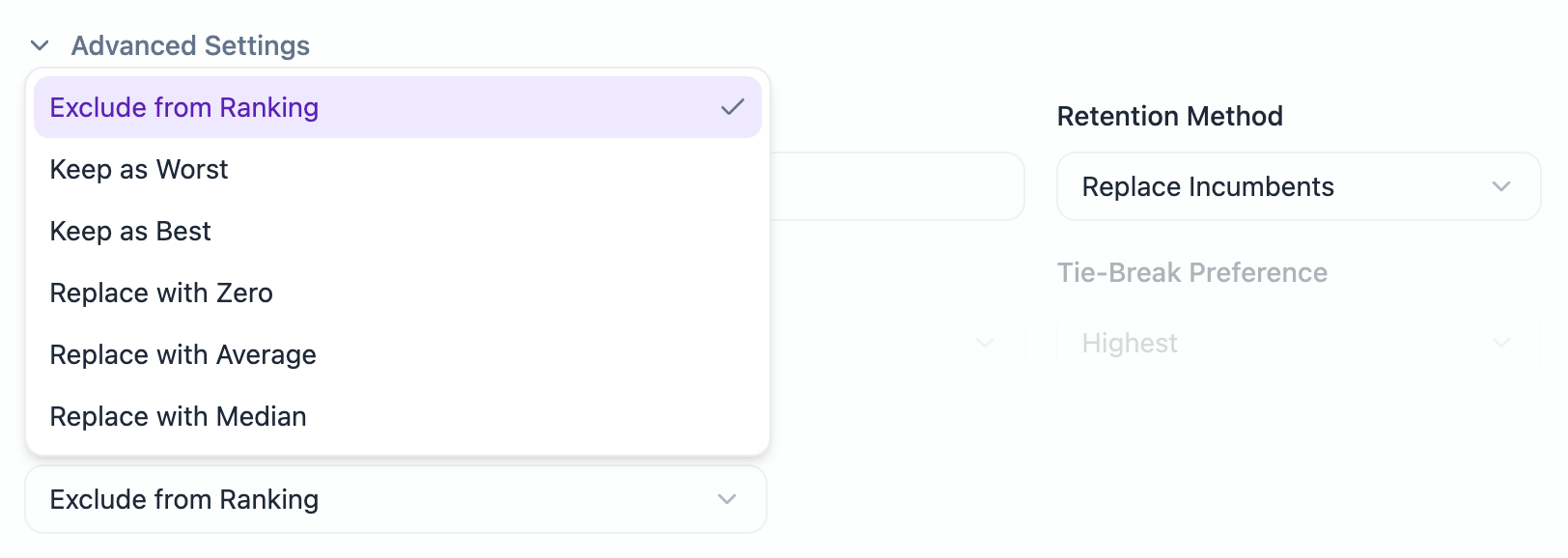
| Policy | Effect on a missing score |
|---|---|
| Exclude from Ranking | Drop the security from the step entirely (default). |
| Keep as Worst | Fill with the worst observed score, so the name ranks at the bottom. |
| Keep as Best | Fill with the best observed score, so the name ranks at the top. |
| Replace with Zero | Substitute 0 for the missing score. |
| Replace with Average | Substitute the cross-sectional mean of valid scores. |
| Replace with Median | Substitute the cross-sectional median of valid scores. |
Machine-Learning Overlays
